

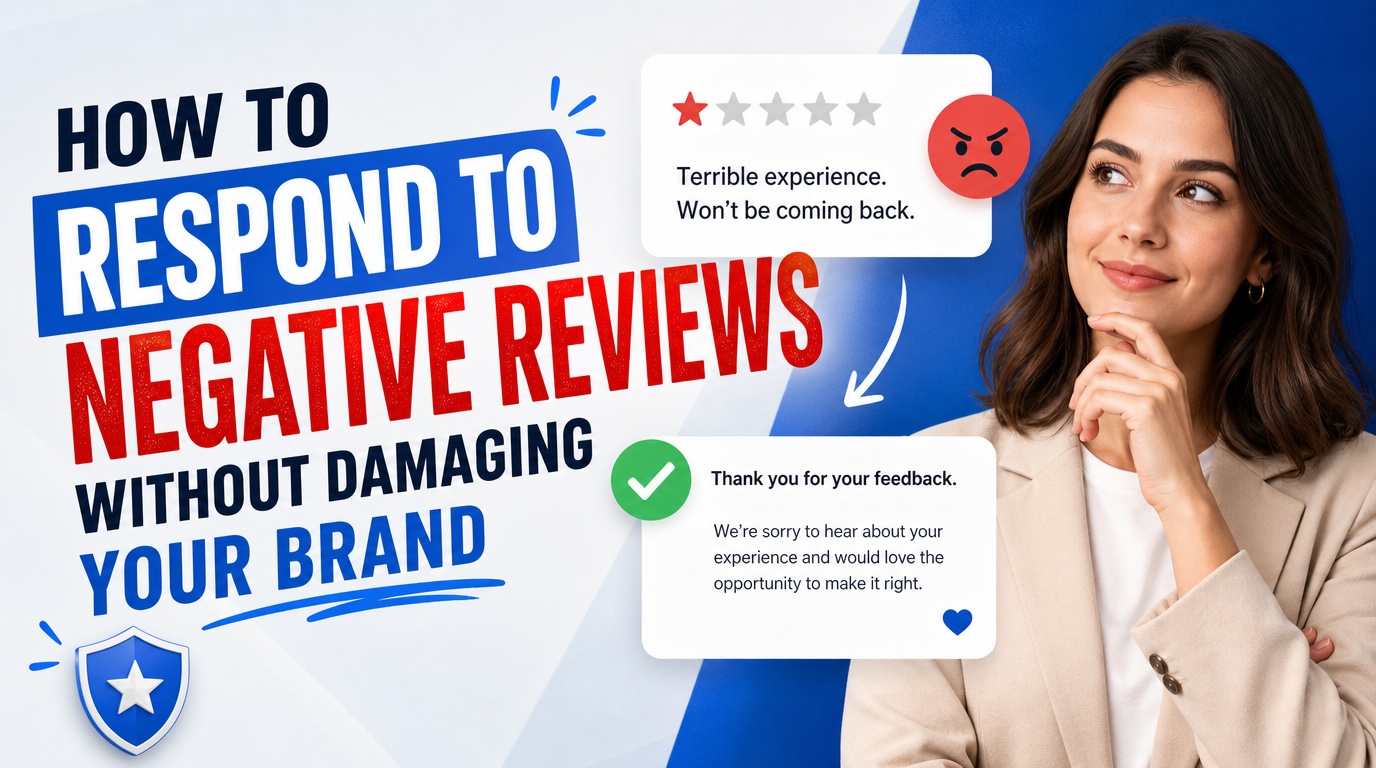
Every local business gets a negative review at some point. It is not a matter of if, but when. What separates businesses that grow from those that struggle is not the absence of bad reviews. It is how they respond to them. Knowing how to respond to negative reviews properly can protect your reputation, build trust with potential customers, and even improve your local search rankings. This guide walks you through everything you need to know, from the first word you type to the follow-up that turns an unhappy customer into a loyal one.
Why Your Response Matters More Than the Review Itself
Most business owners focus entirely on the review. The smarter move is to focus on the response. When someone reads a negative review about your business, they are also looking for how you handled it. Your response tells them far more about your business than the complaint ever could.
According to a 2026 BrightLocal Consumer Review Survey, 89% of consumers read business responses to reviews. That means nearly every person who sees a bad review about you is also reading what you said back. If your response is professional, empathetic, and helpful, that single exchange can actually increase confidence in your business rather than damage it.
Your response also affects your local search visibility. Google’s algorithm considers review activity, including how consistently and quickly businesses respond, as a signal of engagement and trustworthiness. Businesses that actively respond to reviews tend to rank higher in local search results than those that ignore feedback. Responding to negative reviews is not just good customer service. It is also a smart local SEO strategy.
Potential customers use reviews as a trust filter. They are not just reading what went wrong. They are asking themselves: “How does this business treat people when things go sideways?” A thoughtful, respectful response gives them a clear answer.
The Golden Rules for Responding to Negative Reviews
Before you type a single word, there are a few principles that should guide every response you write.
Never respond when emotions are running high. If you read a review that feels unfair or inaccurate, step away from the keyboard. Responding in anger or defensiveness almost always makes the situation worse. Give yourself at least 30 minutes, ideally a few hours, before you draft a reply. The goal is to respond like a professional, not react like someone who just read something upsetting.
Always acknowledge the customer’s experience. Even if you disagree with their account, their experience felt real to them. Start by recognizing that they had a frustrating time. This is not about admitting fault. It is about showing empathy.
Take heated conversations offline. Your public response should be brief and professional. If the situation involves specific details, compensation, or sensitive information, invite the customer to continue the conversation privately. Include a direct email address or phone number so they can reach you easily.
Avoid defensive language and excuses. Responses that begin with “Actually…” or “That is not what happened…” come across as argumentative. Even when you are right, that tone makes your business look bad to everyone reading along.
What to Include in Every Negative Review Response
A well-structured response does not need to be long. It needs to be genuine, specific, and clear. Here is what every response should include.
Start With a Genuine Apology
An apology does not mean you are admitting fault. It means you are acknowledging that the customer had a poor experience. There is a meaningful difference between “We are sorry that happened to you” and “We are sorry we got it wrong.” The first shows empathy without accepting blame in cases where the facts are unclear. The second works when your team clearly made a mistake.
Strong opening lines might sound like: “We are really sorry to hear your visit did not go as expected” or “Thank you for letting us know about this. We understand how frustrating this must have been.” These phrases are warm, human, and set a respectful tone for everything that follows.
Address Specific Concerns Mentioned
Generic responses are easy to spot and they feel lazy. If a customer mentioned that their food arrived cold, reference the food delivery issue in your reply. If they complained about a specific staff member’s attitude, acknowledge that concern directly. This shows you actually read their review and took it seriously, which is the first step toward rebuilding trust.
Specificity also signals to other readers that you take individual feedback seriously rather than using a one-size-fits-all approach. It shows that real people, not bots, are managing your reputation.
Explain Your Side Professionally
Sometimes context matters. If there was a reason for a delay, a policy that the customer may not have been aware of, or an unusual circumstance that contributed to the problem, it is okay to briefly explain that, as long as it does not come across as making excuses. Keep your explanation short and factual. One to two sentences is usually enough. The goal is to give readers a fuller picture, not to win an argument.
Always frame your explanation after the apology, not before. Leading with context before empathy sounds defensive.
Offer a Clear Path to Resolution
Every response should end with a next step. Do not just say “We hope to see you again.” Instead, give the customer a direct way to continue the conversation. Something like: “Please reach out to our team directly at [email] so we can make this right for you” is far more actionable. This shows you are committed to resolving the issue and gives the customer a reason to re-engage rather than walk away permanently.
Response Templates for Common Negative Review Scenarios
Having a starting point for different types of complaints saves time and helps your team stay consistent. These templates are meant to be customized, not copied word for word.
Service Quality Complaints
When a customer says the service was slow, unfriendly, or below expectations:
“Thank you for sharing your experience with us, [Name]. We are truly sorry that our service did not meet the standard you deserved during your visit. This is not the experience we aim to provide, and we take your feedback seriously. We are reviewing this with our team to make sure it does not happen again. We would love the chance to make it right. Please reach out to us directly at [contact info] so we can take care of you.”
This approach acknowledges the issue, commits to improvement without overpromising, and opens the door to a private resolution.
Product or Delivery Issues
For complaints about damaged products, late deliveries, or order errors:
“We are so sorry to hear your order did not arrive as expected, [Name]. This is not the standard we hold ourselves to, and we completely understand your frustration. Please contact us at [contact info] with your order details and we will work quickly to resolve this for you. We appreciate you giving us the chance to make it right.”
For operational issues, always offer a concrete solution, whether it is a replacement, refund, or expedited resolution. Ambiguity frustrates customers further.
Pricing Disputes
When a customer feels they were overcharged or did not receive good value:
“Thank you for your honest feedback, [Name]. We understand that value matters, and we are sorry if our pricing was not clearly communicated upfront. We are always happy to walk through any charges or answer questions about our services. Please give us a call at [contact info] and we will be glad to explain and find a solution that works for you.”
Never be dismissive about pricing concerns, even if you believe the customer misunderstood your policies. Acknowledging their frustration while inviting a direct conversation is always the stronger move.
Misunderstandings or Miscommunication
For reviews that seem to be based on a misunderstanding:
“Thank you for taking the time to share this, [Name]. It sounds like there may have been some confusion about [specific issue], and we sincerely apologize if we did not communicate this clearly enough. We always want our customers to feel fully informed. Please reach out to us at [contact info] and we will be happy to clarify and sort this out for you.”
Taking ownership of communication breakdowns, even when the customer may have misunderstood, shows maturity and builds goodwill.
How to Turn a Negative Review Into a Positive Outcome
A negative review does not have to end negatively. Research shows that 45% of consumers are more likely to visit a business that responds to negative reviews. That means your response is not just damage control. It is an active opportunity to win customers over.
After posting your public response, the next step is to follow up privately. If the customer reached out through the contact information you provided, respond promptly and work toward a resolution. Whether that means a refund, a replacement, an apology call, or simply a chance to redo the experience, following through matters.
Once the issue has been resolved, you can gently let the customer know that updated reviews are always welcome if they feel their experience has changed. Never pressure or incentivize them to change a review. Just make it easy and natural. Something like: “We are glad we could sort this out. If you ever feel moved to share your updated experience, we would really appreciate it.”
Platforms like LinClips make this process much easier by automating follow-up campaigns after issue resolution. Instead of manually tracking every complaint and follow-up, you can set up workflows that reach out to customers at the right moment with the right message, helping you capture updated feedback without adding hours of manual work to your week.
What Never to Do When Responding to Negative Reviews
Knowing what to avoid is just as important as knowing what to say. These mistakes can seriously damage your reputation.
Do not argue or become defensive. Even if a review is completely unfair, arguing publicly makes your business look combative. Other customers reading the exchange will side with the reviewer, regardless of who is technically correct.
Do not question the customer’s honesty publicly. Statements like “We have no record of you visiting our business” come across as accusatory. Even if you suspect a review is fake, address it through platform reporting channels rather than calling the reviewer out publicly.
Avoid copy-paste generic responses. Using the same templated reply for every review signals that you are not really listening. Personalize every response, even slightly, to show genuine attention.
Never ignore negative reviews. Silence is interpreted as indifference. A review with no response looks worse than a review with an imperfect response. Consistency in responding is critical.
Do not ask the customer to remove their review in your public reply. This looks self-serving and can actually draw more negative attention to the review. If you feel a resolution warrants a conversation about an updated review, handle that privately.
How to Use Review Management Tools to Stay on Top of Feedback
For businesses managing reviews across Google, Facebook, Yelp, and other platforms, staying organized is half the battle. Review management tools help you respond faster, stay consistent, and never miss a piece of feedback.
Start by setting up real-time notifications so you are alerted the moment a new review is posted. A faster response time signals to both customers and search engines that your business is active and engaged. According to a 2026 ReviewTrackers study, 53% of customers expect a business to respond to a negative review within a week, and ideally much sooner.
Creating response workflows for your team is another important step. Assign ownership for review responses, establish tone guidelines, and build a library of approved templates that team members can adapt quickly. This keeps your voice consistent even when different people are handling responses.
Tracking your response rate and average response time gives you useful performance data. Platforms like LinClips allow you to monitor these metrics alongside your overall review sentiment, so you can see how your reputation is trending and where to focus your efforts.
Automation also plays a key role in modern review management. When a customer submits feedback or a support interaction closes, automated workflows can trigger a follow-up message at the right time, ensuring no review goes unanswered and no opportunity to re-engage a customer is missed.
When to Seek Removal of a Review
Not every negative review deserves a removal request, and submitting one unnecessarily can waste your time. But some reviews genuinely violate platform policies and should be flagged.
Reviews that qualify for removal typically fall into specific categories. On Google, reviews can be removed if they contain spam, are clearly fake, include hate speech, discuss a competitor rather than your business, or were left by someone who was never actually a customer. Yelp and Facebook have similar policies around fraudulent or irrelevant content.
If you believe a review violates platform guidelines, document your case before reporting it. Take a screenshot, note the specific policy the review appears to violate, and submit a clear, factual report through the platform’s official process. Avoid emotional language in your report. Keep it factual and policy-focused.
What does not qualify for removal is simply a review you disagree with. A one-star review that expresses genuine dissatisfaction, even if it feels unfair, is protected opinion. The right response to those is a thoughtful public reply, not a removal request. Trying to remove legitimate negative reviews can backfire, especially if the customer notices and escalates the situation publicly.
Measuring the Impact of Your Review Response Strategy
Responding to reviews is a strategy, not just a task. Like any strategy, it should be measured so you can improve it over time.
Start by tracking your overall review sentiment across platforms. Are your average star ratings improving month over month? Are the themes in negative reviews changing, which might indicate that specific operational issues are being addressed? Sentiment tracking gives you a bird’s-eye view of your reputation health.
Monitor conversion rates from review platforms where possible. Google Business Profile Insights can show you how often users who visited your listing went on to call your business, request directions, or visit your website. If those numbers improve as you become more consistent in responding, you are seeing the direct impact of your reputation strategy.
Analyze the relationship between your response time and customer satisfaction signals. Businesses that respond to reviews within 24 hours consistently report stronger customer relationships and higher review volumes over time. Faster responses tend to generate more positive follow-up interactions.
Use this data to refine your templates, adjust your tone, and identify the types of complaints that appear most frequently so you can address them at the source. Reputation management is an ongoing process, and the businesses that treat it as one will always outperform those that handle it reactively.
Frequently Asked Questions
How quickly should I respond to a negative review?
The ideal response time for a negative review is within 24 to 48 hours. Responding quickly shows that you are attentive and that customer feedback matters to you. A 2026 ReviewTrackers study found that 53% of customers expect a response within seven days, but faster responses consistently lead to better outcomes. If you need time to gather information before responding, a brief acknowledgment within 24 hours is better than silence.
What should I do if a negative review contains false information?
Start by responding calmly and professionally without directly accusing the reviewer of lying. You can gently clarify facts in your response, such as noting that your records show a different outcome, while still acknowledging their frustration. If the review is genuinely fabricated, report it to the platform through the appropriate channel. Google, Yelp, and Facebook all have processes for flagging reviews that violate their content policies.
Should I respond to every negative review or just some of them?
Yes, you should respond to every negative review. Selective responses make it look like you only engage when convenient. Consistency signals professionalism and care. Even a brief, genuine response to a one-star review with no written content is better than no response at all. Every response is also visible to potential customers, making it an ongoing opportunity to demonstrate your values.
Can responding to negative reviews actually improve my local SEO?
Yes. Google views review activity, including business responses, as an engagement signal. Responding to reviews regularly shows Google that your business listing is actively managed, which can positively influence your local search rankings. Review responses also increase the amount of keyword-rich content associated with your listing, which supports your visibility for relevant searches.
How do I get my team trained on responding to reviews professionally?
Start with a simple response guide that covers tone expectations, approved templates, and common scenarios. Role-play a few examples during onboarding or team meetings. Define who is responsible for reviewing and posting responses and set a standard response time. Platforms like LinClips can help by providing a centralized place for your team to manage and respond to reviews consistently, reducing the chance of off-brand or reactive replies.
What if the customer does not respond to my offer to make things right?
Some customers will not respond, and that is okay. The public response you left is still visible to everyone who reads that review. The fact that you offered a resolution professionally is what matters to potential customers who are evaluating your business. Keep the door open with a warm, non-pressuring message and move forward. Not every interaction will result in a changed review or a direct resolution, and that is a normal part of reputation management.
Should I offer refunds or discounts in my public response?
Generally, no. Offering specific compensation in a public response can set a precedent that encourages others to leave negative reviews in hopes of receiving discounts. Instead, invite the customer to contact you directly to resolve the issue. In that private conversation, you have the flexibility to offer whatever resolution you feel is appropriate without broadcasting it to every future reviewer.
Knowing how to respond to negative reviews is one of the most valuable skills a local business can build. Every response you write is a reflection of your brand, your values, and your commitment to the people who choose to do business with you. When handled well, even a one-star review becomes proof that your business listens, cares, and shows up when things go wrong. That kind of trust is hard to buy and easy to build, one response at a time.
Leave a Reply